Start a photo magnet business
Sell photo magnets at events without juggling five phones.
What it takes to start: the gear, the math, the booth setup, and how to skip the chaos that breaks most first-year vendors. Plus the platform that runs the ordering, payment, and print queue while you press magnets.
Why photo magnets
Low overhead, high margin, and customers walk away with a keepsake.
Photo magnets are one of the most accessible vendor businesses you can start. The gear footprint is small enough to fit in a car, the materials are cheap relative to retail, and the product is something people actively want at events — a personal keepsake, printed and handed over within minutes.
The challenge is not the product. It's everything else: taking orders without losing track, getting paid without a card reader pile-up, and laying out print sheets fast enough to actually keep up with your line. That is what most first-year vendors burn out on, and it's what Vixie exists to remove.
60–75% margins
After magnet sheets, paper, ink, and event fees, most vendors clear 60–75% on each magnet. Puzzle magnets often beat 70%.
$5K–$15K starting cost
A printer ($300–$1,500), magnetic sheets ($100–$300), a press or cutter ($150–$500), tablet, table, samples. Many vendors start under $2K.
Recurring weekend income
Most vendors run weekly markets plus a calendar of festivals. Predictable, repeatable, and the same gear runs every event.
The gear
What you actually need to start.
There's a lot of gear advice online from people who don't sell magnets at events. This is what the vendors in our community actually use.
A photo printer
Three common picks: Canon Selphy CP1500 (small, cheap, dye-sub, great for 4×6 magnets), Epson SureColor or EcoTank (versatile, larger sheets, cheap ink), or DNP DS620 (commercial photo booth printer, fast and bulletproof at high volume). Pick based on volume — Canon for small markets, DNP for high-traffic events.
Magnetic sheet stock
12mil or 20mil printable magnetic sheets (Magnum, Sihl, or Ultra) covers both flat photo magnets and puzzle magnets — same stock, same press. Buy in bulk; per-unit cost drops 30–50% at 50+ sheets.
A cutter
A guillotine cutter or rotary trimmer handles both flat magnets and puzzle pieces. Vixie's print sheet includes cut guides for every magnet. Skip the laser cutter — overkill at this volume.
A tablet (optional)
Used to be required for vendor-driven orders. With Vixie, customers order from their own phone, so the tablet is optional. Useful as a backup display for showing samples.
Payment infrastructure
Vixie handles this through Stripe, PayPal, or Square — customers pay themselves at checkout from their phone. No card reader, no Square terminal, no hand-off. If you are running cash too, a small float ($100 in 5s and 1s) covers the few customers who insist.
A booth
A 10×10 tent if you are outside, a folding table, a clear price board, and a sample magnet wall (about 40–60 magnets). The sample wall sells more than any pitch.
Playbook
Your first event, step by step.
What we tell every new vendor before their first market or photo booth gig.
- 1
Two weeks before: book the event and price the products
Confirm the booth fee, table size, and power access. Vixie's default pricing is a great starting point: $6 single magnet, $17 / 3-pack, $32 / 6-pack, $45 / 9-pack, plus puzzle magnets from $15 (6-piece) up to $35 (16-piece). Adjust up or down based on your event's price ceiling — boutique festivals tolerate +20%, dollar-store-adjacent markets need -10%.
- 2
One week before: sample wall and inventory
Press 40–60 sample magnets you actually like. Mix sizes. Buy enough magnet sheets and paper for 2× your conservative estimate of demand. Set up a Vixie account and configure your subdomain (yourbrand.vixie.shop), products, and prices.
- 3
Day-of, two hours early: setup and test
Tent, table, sample wall, printer plugged in, QR codes printed. Place a Vixie dummy order from your own phone to confirm payment lands and a print sheet generates. Pre-press a small inventory of your three top sizes so the first customer of the day does not wait on cold equipment.
- 4
During the event: press, do not type
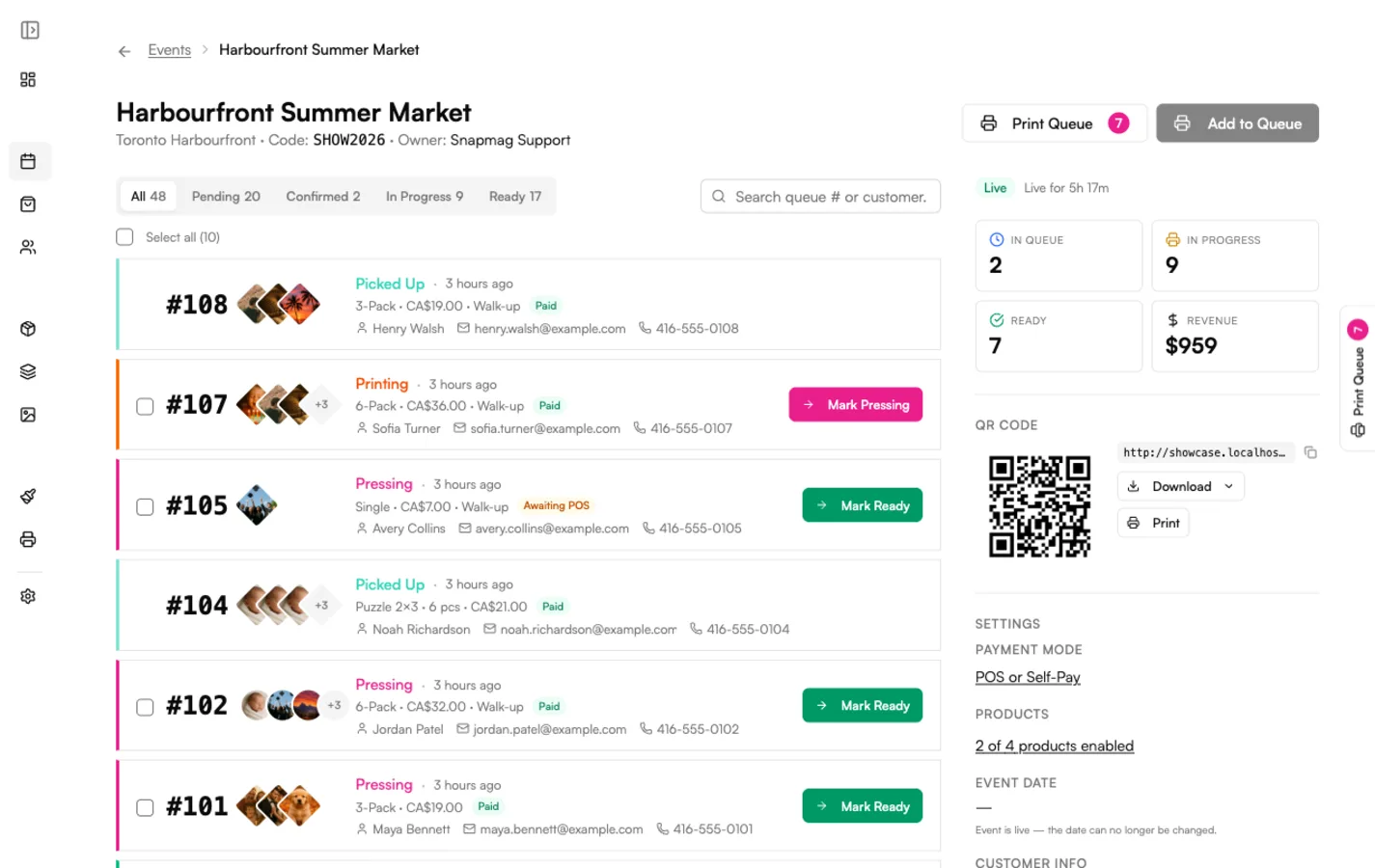
Customers scan and order on their phone. The Vixie print queue handles the layout. Your job is press, peel, cut, hand off. If the line gets long, batch print 4–8 at a time and call orders in the order they paid.
- 5
After: review, restock, repeat
Vixie's order board shows you what sold and what didn't. Bump pricing on hits, drop slow movers, and restock the magnet sheets that ran low. The same setup runs the next event.
The platform
What Vixie actually replaces.
The bottleneck at most magnet booths is not pressing — it is everything around the press. Vixie removes the parts that don't make money:
- Tablet ordering & passing phones around → customers self-serve from their own phone
- Card reader pile-up → Stripe / PayPal / Square checkout on the customer's device
- Receipts and post-it notes → live order board with payment status
- Canva layout between customers → auto-arranged print-ready sheets
- Spreadsheet sales tracking → real-time revenue and product breakdown
Questions
Photo magnet business FAQ
How much can I make selling photo magnets at events?+
What gear do I need to start?+
How long does it take to print and press one magnet?+
Do I need permits to sell at markets?+
Can I run this as a side business?+
What's the biggest mistake new vendors make?+
Should I start with photo magnets or puzzle magnets?+
Keep going
Related reads.
Magnet profit calculator
Punch in your costs, price, and booth fee to see your real profit, margin, and break-even — before you book the next craft fair.
Read more →Setup · 30 minGetting started with Vixie
Account, payments, products, branding, and your first event in about 30 minutes.
Read more →Free toolFree Print Studio
Drag-and-drop sheet layout for mixed-size and puzzle magnets — free in your browser.
Read more →Show up to your first event with the booth already running.
Set up your products, your subdomain, and your QR code in 30 minutes. Plans from $29/mo, 4-day free trial, no credit card required.
Start Free 4-Day Trial